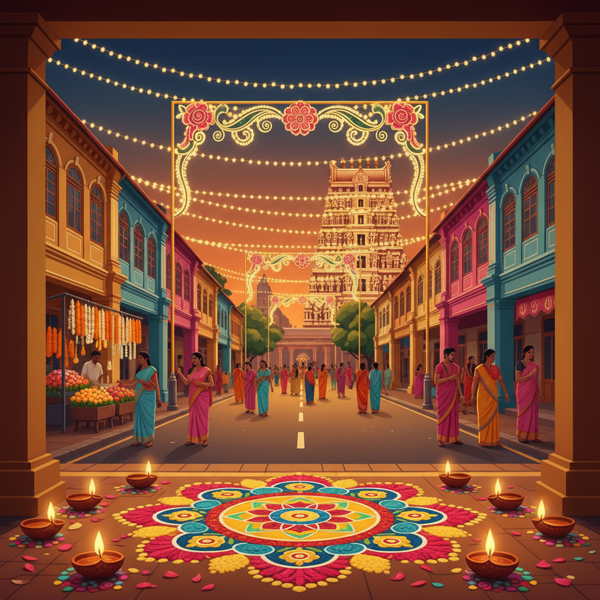
Serangoon Road after dark, once a year
For about a month leading up to Deepavali, a stretch of Serangoon Road turns into one of the most photographed streetscapes in Singapore. Hundreds of thousands of lights form arches across the road, and the colonnaded shophouses of Little India get dressed up in strings of bulbs and coloured panels. Thousands of visitors show up nightly. And that's just the light-up, the actual festival has far more going on underneath the surface.
Deepavali 2026 falls on Sunday 8 November, with Monday 9 November as the in-lieu public holiday. That makes it one of the rare three-day weekends of the year without spending a leave day, which means the crowds in Little India will be especially heavy. Here's what's happening and how to get the most out of it.
What Deepavali actually celebrates
Deepavali (or Diwali) means "row of lights" in Sanskrit, and the festival commemorates the triumph of light over darkness and good over evil. The specific mythology varies by region of origin: North Indian Hindu traditions focus on Rama's return to Ayodhya after defeating the demon king Ravana, while Tamil Hindu traditions (the majority in Singapore) remember Krishna defeating the demon Narakasura.
Singapore's Indian community is predominantly Tamil, but the Deepavali celebrations in Little India deliberately blend traditions from across South Asia. You'll see Tamil Brahmin households lighting oil lamps (vilakku), North Indian families bursting firecracker-equivalent sparklers (actual firecrackers are banned in Singapore), and Sikh gurdwaras in Little India hosting their own community meals the same weekend.
The light-up and the bazaar
The Deepavali Festival Village runs from around a month before Deepavali up to and just past the holiday. It typically sets up at the open field next to Mustafa Centre on Campbell Lane or at the Hastings Road site, and includes:
- Open-air stalls selling saris, gold jewellery, kolam decorations, festival clothing, and rows of sweets
- Sweet stalls with laddu, jalebi, mysore pak, and Singapore-specific Indian-Muslim sweets like murukku
- Flower garlands for temple offerings and home decor
- Henna artists offering quick designs for visitors
The light-up itself covers Serangoon Road between Tekka Market and Rangoon Road, plus the side streets around Campbell Lane and Cuff Road. It typically turns on in early October and stays lit through the first week of November. The best photo angles are near the junction of Serangoon Road and Cuff Road, or standing by Mustafa Centre looking south.
Temple visits worth timing
Three temples in the Little India area become the focal points for prayers and offerings during Deepavali:
- Sri Veeramakaliamman Temple on Serangoon Road, built in 1881 and dedicated to the goddess Kali. Expect extremely long queues on Deepavali morning.
- Sri Srinivasa Perumal Temple further up Serangoon Road, the starting point of Singapore's annual Thaipusam procession. Dedicated to Vishnu.
- Sri Thendayuthapani Temple on Tank Road (not in Little India itself but related), the end point of Thaipusam and an important Tamil Chettiar community space.
If you want to observe prayers without joining the queue, arrive around 6 am or after 9 pm. If you're photographing the temples, ask permission, and don't photograph the inner sanctum or active worshippers without consent.
What to eat and where
Deepavali weekend is one of the best eating weekends of the year in Little India. Suggested rounds:
- Banana leaf rice at Muthu's Curry (Race Course Road) or Samy's Curry (Dempsey, but with Singapore-Indian roots)
- Vegetarian thali at MTR 1924 on Dickson Road for a pure vegetarian option
- South Indian breakfast at Ananda Bhavan for masala dosa or idli
- Sweets for the altar or as gifts: Komala Vilas on Serangoon Road is a Deepavali sweets institution
- Indian-Muslim roti prata and biryani at Tekka Centre, especially the upstairs hawker stalls
If you're visiting Singapore specifically for Deepavali, book ahead at the sit-down restaurants. Walk-in queues during Deepavali week are genuinely brutal.
The long weekend planning angle
Because Deepavali falls on Sunday 8 November 2026, Monday 9 November becomes a public holiday in lieu. That gives you a default three-day weekend from Saturday 7 November to Monday 9 November, perfect for:
- Doing the Little India walk at a leisurely pace on Saturday evening
- Attending prayers at a temple on Sunday morning
- Spending Monday recovering or visiting friends for open house
If you want to stretch further, take Tuesday 10 through Friday 13 November off for a nine-day break. See our long weekend planning guide for the full 2026 playbook. The November 2026 calendar gives you the visual layout.
Cultural etiquette for non-Hindu visitors
Little India welcomes visitors year-round, and Deepavali weekend is no exception. A few things to keep in mind:
- Dress modestly if visiting temples: covered shoulders, knees below the knee. Most temples provide sarongs at the entrance if needed.
- Remove shoes before entering any temple in Singapore. This is non-negotiable.
- Ask before photographing people. The festive atmosphere makes it tempting, but always consent first.
- Don't touch the kolam patterns on the ground. These are elaborate rangoli designs and are considered sacred offerings.
- Eat with your right hand if dining traditional-style on a banana leaf. This is the custom regardless of whether you're Hindu or Muslim.
Beyond the tourist view
The easy thing to do is walk Serangoon Road once, snap a few photos, and leave. The richer experience involves going a second time, midweek, when the crowd thins out. You'll notice the small things: the temple priests chanting at dawn, the sari shop owners arranging their morning displays, the flower sellers threading garlands while the shophouse shadows stretch across the road.
Deepavali in Singapore isn't just a photo opportunity. It's a living tradition that shapes how a significant community marks its year. The 8 November 2026 day page shows the holiday in context, and the 2026 calendar lets you plan the rest of your year around it.