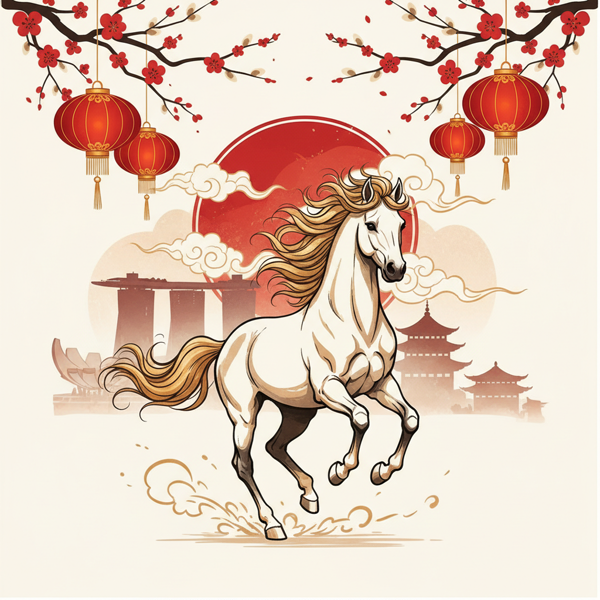
One zodiac, twelve years, Singapore's refresh button
Every 12 years the Chinese zodiac cycles through, and every time a new animal takes over, millions of Chinese Singaporeans pay a little more attention to what the year might bring. 2026 is the Year of the Horse, officially beginning on Tuesday 17 February 2026 (the first day of the lunar new year), and running through Wednesday 17 February 2027.
For a city where roughly three-quarters of the population is Chinese, the zodiac isn't just folklore. It shows up in baby-naming decisions, wedding date choices, property purchase timing, and even in how some Chinese Singaporean families decorate their HDB flats. Here's what the Year of the Horse traditionally represents and how Singapore welcomes it.
What the Horse symbolises
In Chinese astrology, the Horse is the seventh animal in the 12-animal zodiac cycle. Horses are associated with:
- Freedom and independence: horses are natural wanderers, and the Year of the Horse is traditionally seen as a year of travel, career change, and bold moves
- Energy and momentum: decisions made quickly, opportunities seized rather than pondered
- Passion: relationships, hobbies, and creative pursuits benefit
- Honesty: horses are considered direct and straightforward animals in Chinese tradition
In the Five Elements cycle, 2026 is a Fire Horse year (specifically, Yang Fire paired with the Horse). Fire Horse years happen every 60 years (the last was 1966, the next after 2026 is 2086), and they carry a reputation for being particularly intense. Chinese tradition holds Fire Horse years as dramatic, ambitious, and occasionally volatile.
How Chinese Singaporeans traditionally mark a zodiac transition
A few days and weeks before the new lunar year, Chinese households across Singapore do a roughly standard set of things:
- Spring cleaning ("da sao chu"): deep cleaning the home to sweep away the old year's bad luck. Technically this should be done before the first day of the new year, never during, because sweeping on day one is believed to sweep away incoming good fortune.
- Buying new clothes: a fresh outfit (traditionally with some red) to wear on the first day of Chinese New Year.
- Visiting flower markets: the one at Chinatown runs throughout the lead-up weeks, selling kumquat trees, peach blossoms, pussy willow branches, and orchids. The flowers are carried back to HDB flats in taxis and PMDs, a distinctly Singapore scene.
- Stocking up on mandarin oranges: given and received during visiting, always in even numbers.
For the Year of the Horse specifically, some families also hang horse-themed decorations. You'll see galloping horse paintings (symbolising rapid advancement) and horse figurines made of wood, brass, or jade at temple shops and in Chinatown.
The zodiac compatibility question
A Singaporean-specific quirk: when pregnancy timing allows, some Chinese families try to plan for certain zodiac years. The Dragon (2024, 2036) is famously the most desired, leading to visible baby booms. The Horse is also considered auspicious, especially for boys, but the Fire Horse variant is more complicated. Old Chinese superstition held that Fire Horse girls would be headstrong and difficult to marry off, which caused some Chinese communities to avoid having daughters in 1966. Modern Singapore largely disregards this.
For compatibility between zodiac signs:
- Best matches with Horse: Tiger, Sheep, Dog
- Challenging with Horse: Rat (direct opposition), Ox, Rooster
- Neutral: Rabbit, Dragon, Snake, Horse, Monkey, Pig
If you want to test this, the next Chinese New Year gathering will have at least one auntie who calculates everyone's compatibility on the spot.
Temple visits on the first day
Many Chinese Singaporean families start the Year of the Horse with a first-day visit to a temple to pray for prosperity and safety. Popular temples for this include:
- Thian Hock Keng Temple on Telok Ayer Street: the oldest Hokkien temple in Singapore, dedicated to Mazu the sea goddess
- Kwan Im Thong Hood Cho Temple at Waterloo Street: dedicated to Guanyin, famously packed on the first day of Chinese New Year
- Buddha Tooth Relic Temple in Chinatown: a newer but beautiful Tang-style temple
- Shuang Lin Monastery in Toa Payoh: a traditional Buddhist monastery with stunning architecture
Queues at Kwan Im Thong on first-day morning start forming from midnight. It's one of the most photographed Singapore scenes of the year.
Predictions and readings
Chinese temples and bookstores in Singapore sell "feng shui almanacs" ("tong shu") and yearly predictions from various feng shui masters. The tradition is that each zodiac sign gets a different forecast for the year ahead. Year of the Horse traditionally predicts:
- Horse (self-sign year, "ben ming nian"): a year of transformation but also challenges. Wearing red is customary to ward off bad luck.
- Tiger, Sheep, Dog: most auspicious, good for career and relationships
- Rat: most challenging, the direct opposition sign
- Other signs: mixed, with specific months highlighted as good or bad
Take all of this with the humour it deserves. Feng shui predictions in Singapore are enjoyed as culture and family tradition, not as literal life planning by most people.
The Chinese New Year 2026 dates
For planning purposes, the key dates in Singapore:
| Date | What it is |
|---|---|
| Mon 16 Feb 2026 | Chinese New Year Eve (reunion dinner) |
| Tue 17 Feb 2026 | First day of CNY (public holiday) |
| Wed 18 Feb 2026 | Second day of CNY (public holiday) |
| Wed 25 Feb 2026 | Ninth day (Bai Tian Gong for Hokkiens) |
| Tue 3 Mar 2026 | 15th day (Chap Goh Meh, end of CNY period) |
The first two days are the official gazetted public holidays. See 17 February 2026 and 18 February 2026 for the day views.
Welcoming the Horse into your home
Common Singapore household traditions for the new year:
- Red packets (ang bao) given to younger, unmarried relatives, always in even numbers and never ending in 4
- New year cookies: pineapple tarts, kueh bangkit, love letters, arrowhead chips, and every variation of peanut and almond cookie
- Spring couplets (chun lian) pasted around the main door of the flat, usually in bright red with gold lettering
For deeper dives into how specific dialect groups celebrate, see our Chinese New Year dialect traditions article. For leave planning around the holiday, see the long weekend guide for 2026.
Happy Year of the Horse in advance, or as we say in Singapore, gong xi fa cai.