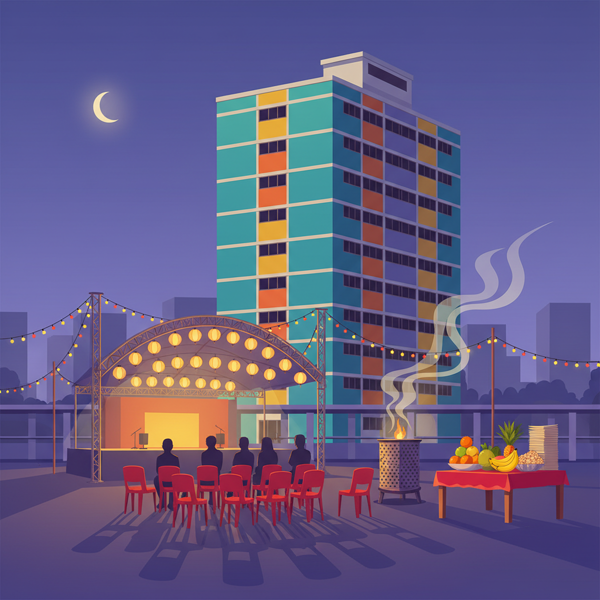
The month Singapore gets a little quieter
Every year around mid-August or September, HDB estates across Singapore change subtly. Steel burners appear near void decks, filled with smouldering joss paper. Offerings of rice, oranges, peanuts, and whole roast pigs get laid out at the edges of carparks and grass patches. Some evenings, entire blocks echo with loud cantonese opera, Hokkien getai performances, or mass religious chanting.
This is the Hungry Ghost Festival, known in Mandarin as Zhong Yuan Jie and in Hokkien as Phor Thor. It's one of the most visible religious observances in Singapore's Chinese calendar and one that many younger Singaporeans grow up partly participating in without fully understanding. Here's what the month is actually about and how it plays out specifically in Singapore's HDB context.
When it happens in 2026
The Hungry Ghost Festival runs for the entire seventh lunar month, which in 2026 corresponds roughly to 13 August 2026 through 10 September 2026. The peak day (the 15th day of the lunar month, when the "ghost gate" is said to open fully) falls on Thursday 27 August 2026.
None of these dates are Singapore public holidays, but they're observed across many Chinese-majority HDB estates. The festival overlaps with the lead-up to National Day and its in-lieu Monday, which is worth noting for anyone planning August 2026 activities.
What the festival commemorates
Hungry Ghost Festival draws from both Buddhist and Taoist traditions, with roots in Chinese folk religion. The core belief: during the seventh lunar month, the gates of the afterlife open and the spirits of deceased relatives, along with "hungry ghosts" (wandering souls without living descendants to care for them), are free to roam the living world. During this time, the living offer food, money (in the form of joss paper), and entertainment to:
- Appease their own ancestors and ensure their comfort in the afterlife
- Feed hungry ghosts who have no one to remember them
- Avoid negative encounters with wandering spirits who might cause harm if ignored
The festival's merit-making aspect is especially strong in Buddhist traditions, where offerings and prayers during the seventh month are believed to benefit departed relatives.
The HDB void deck getai tradition
One of the most distinctly Singaporean aspects of Hungry Ghost Festival is getai (literally "song stage"). Community organisations rent out void decks or open fields in HDB estates and set up full concert-style stages for nightly performances throughout the seventh month. Typical getai programmes include:
- Hokkien and Teochew opera: traditional, dramatic, and often hilariously over-the-top
- Pop singers: modern Mandarin and dialect singers performing classics and new tunes
- Comedy and emcee skits: slightly risqué humour, audience interaction
- Auction nights: auspicious items (statues, giant joss sticks) auctioned for charity, with bids sometimes reaching tens of thousands of Singapore dollars
The front row of seats at a getai is traditionally left empty because those seats are reserved for the spirits attending the performance. Live humans sit from the second row onwards. If you see empty front seats at a void deck concert in September, that's why.
Getai performances started in the 1940s and peaked in popularity through the 1990s, declining somewhat with younger generations. They've been enjoying a mild revival in recent years as a nostalgic cultural experience.
The burning of joss paper
Throughout the seventh month, you'll see metal barrels or bins placed near HDB blocks and carparks specifically for burning joss paper (also called "hell money" or "ghost money"). The burning is an offering of symbolic currency to the deceased. In Singapore, the Town Councils coordinate designated burning sites and times to manage fire safety and air quality.
Common things burned:
- Hell banknotes in high denominations (the larger the number, the better)
- Joss paper folded into ingots, representing gold and silver bars
- Paper replicas of modern goods: paper cars, paper iPhones, paper mahjong sets, paper bungalows. These are believed to transfer to the deceased for use in the afterlife.
The smoke and ash can be heavy on peak days. If you live near a heavy-observance block, you'll want to close windows on those evenings. The NEA encourages all burning to happen in designated bins to minimise smoke spread.
Do's and don'ts during the seventh month
Chinese Singaporeans who observe the festival typically follow a set of traditional cautions during the seventh lunar month. Even non-religious Chinese families often passively observe some of these because "it doesn't cost anything to be careful":
Don'ts:
- Don't move house or sign major property contracts. Auspicious dates are preferred in other months.
- Don't get married during the seventh month. Wedding bookings drop sharply.
- Don't whistle at night, especially in lifts or corridors. Whistling is believed to attract spirits.
- Don't step on or kick offerings you see on the ground or at the edge of carparks. Walk around them.
- Don't pick up money you find on the ground during the seventh month, especially if it's placed deliberately.
- Don't swim in open water at night. Traditional belief: water spirits are more active during the seventh month.
Do's:
- Arrive home before midnight if possible, especially on the 15th and final days
- Keep a small altar at home if your family observes the tradition
- Carry something with personal significance (a family photo, a protective charm) for peace of mind
How non-Chinese Singaporeans interact with the festival
Singapore's HDB estates are multi-racial by design, which means non-Chinese residents live alongside observers of the festival year after year. Most Malay, Indian, and expat neighbours:
- Respect the burning bins and offerings, walking around rather than through them
- Tolerate the noise of getai performances as a neighbourhood occurrence
- Don't participate directly but appreciate the cultural richness
Conflicts occasionally arise over smoke and noise, but Town Councils and community leaders typically mediate these respectfully. The festival is a good example of Singapore's practical multiculturalism in action.
For visitors curious to see it
If you're in Singapore during the seventh month and want to experience the festival:
- Visit an HDB estate on an evening: Ang Mo Kio, Tampines, and Bishan have traditionally active community observance
- Attend a getai performance: they're free and open to the public. Check the Chinese language papers or ask a Singaporean friend for the schedule.
- Stop by a temple: the Singapore Buddhist Federation coordinates major observances. Most Chinese temples hold special services during the month.
- Don't photograph offerings up close without asking. Be respectful if you spot a family actively praying.
For a broader view of how Chinese calendar traditions show up in Singapore, see our Year of the Horse 2026 article or the 2026 calendar for how the lunar seventh month aligns with the gazetted holidays. More about the site and its sources on the about page.