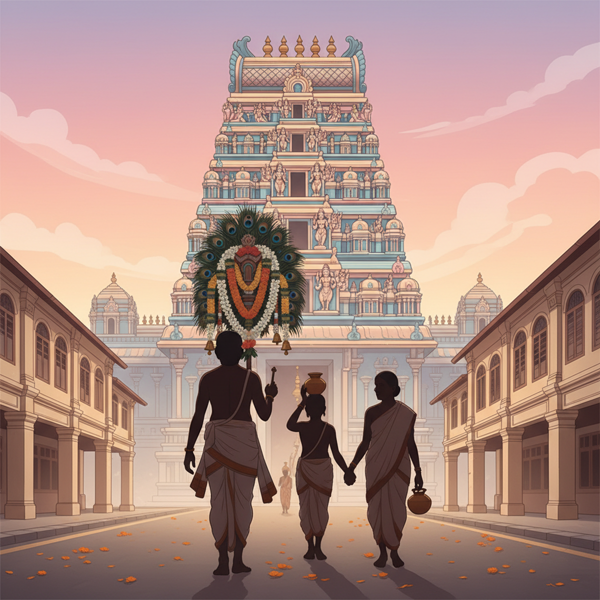
The quietest and loudest day in Little India
Thaipusam is one of Singapore's most striking religious festivals, and also one of the most misunderstood. For a full day, thousands of Tamil Hindu devotees carry ornate metal structures called kavadis on a 4 km walk from the Sri Srinivasa Perumal Temple on Serangoon Road to the Sri Thendayuthapani Temple on Tank Road. Many pierce their skin, tongue, or cheeks with hooks and skewers. They walk barefoot through Singapore's city streets, often for four to six hours, accompanied by family members chanting and carrying pots of milk.
Thaipusam isn't a Singapore public holiday. It was removed from the gazette in 1968, unlike Vesak Day or Hari Raya. But the procession still draws massive crowds, and the Ministry of Home Affairs coordinates traffic, crowd control, and permits for the event every year.
When Thaipusam happens
Thaipusam falls on the full moon day of the Tamil month of Thai, which typically corresponds to late January or early February. The exact date varies year to year based on the Tamil calendar. For context, recent dates have been:
| Year | Thaipusam date |
|---|---|
| 2024 | Thursday 25 January |
| 2025 | Tuesday 11 February |
| 2026 | To be confirmed by the Hindu Endowments Board |
While it isn't on the public holiday calendar for 2026, the Tamil community, the Hindu Endowments Board, and the two temples confirm the date in advance.
Who carries kavadis, and why
The kavadi bearer is called a kavadi aattam, and carrying one is an act of religious devotion, vow fulfilment, or penance. Typical reasons:
- Gratitude for a prayer answered (a family member recovered, a child was born, a career was saved)
- Penance for a specific action or to atone for past transgressions
- Devotion to Lord Murugan, the Hindu god of war and youth, to whom Thaipusam is dedicated
Preparation for carrying a kavadi is serious. Devotees typically undergo 48 days of spiritual preparation that includes:
- Strict vegetarian diet (no meat, fish, onions, garlic, alcohol)
- Celibacy during the preparation period
- Daily prayer and meditation
- Sleeping on the floor, not on a bed
- Wearing yellow or orange clothing symbolising humility
The piercings happen on the day of Thaipusam, usually at dawn at the Perumal Temple. Devotees enter a meditative trance state before the piercings are done, often accompanied by drums and chanting. Many say they feel no pain during the walk.
The procession route
The 4 km route runs from Sri Srinivasa Perumal Temple on Serangoon Road (in Little India) to Sri Thendayuthapani Temple on Tank Road (near the Orchard area). The typical path:
- Start: Sri Srinivasa Perumal Temple, 397 Serangoon Road. Devotees and milk-pot bearers gather from 3 am onwards.
- Selegie Road: turn south past Rochor Canal
- Bras Basah Road and Orchard Road junction: one of the busiest parts of the walk
- Tank Road: final approach
- End: Sri Thendayuthapani Temple, 15 Tank Road
The procession runs from about 5 am through to late evening, with the peak crowd between 9 am and 1 pm. Police cordon off stretches of Serangoon Road, Selegie Road, and Tank Road for safety. Observers line the entire route, often cheering on devotees and offering water or rose petals.
What spectators should know
If you're watching Thaipusam in Singapore for the first time:
- It's respectful, not touristy: while photography is allowed, keep a respectful distance from devotees and their families. Use flash sparingly or not at all.
- Music restrictions are strict: Singapore prohibits live music along the procession route except for specific approved segments. This was a policy introduced in the 1970s and remains in place. You'll see musicians only at certain designated rest stops.
- Free water and snacks: many Tamil organisations set up stalls along the route offering water, rose water, buttermilk, and light snacks to both devotees and spectators. Accept with both hands.
- Don't touch a kavadi bearer: the metal structures are genuinely heavy and finely balanced. Accidental contact can hurt the devotee.
- Early is best: arrive at Perumal Temple by 6 am to see the preparations, piercings, and first departures. The atmosphere at dawn is entirely different from midday.
The two temples in detail
Sri Srinivasa Perumal Temple (Little India) was built in 1855 and dedicated to Lord Vishnu. It's one of the oldest Hindu temples in Singapore and has been a gathering place for the Tamil community for over 170 years. The tower (gopuram) at the entrance is a five-tier masterpiece of South Indian temple art.
Sri Thendayuthapani Temple (Tank Road) was founded in 1859 by Nagarathar Chettiar community, who migrated from the Chettinad region of Tamil Nadu. It's dedicated to Lord Murugan and is the final destination of the Thaipusam procession. The temple's Chettiar connection has historical significance because the Chettiar moneylenders played a major role in Singapore's colonial economy.
Both temples remain active places of worship year-round and welcome respectful visitors outside of Thaipusam. Little India as a whole sits nearby, making it easy to combine a Perumal Temple visit with a walk through Serangoon Road.
Why Thaipusam matters beyond the spectacle
It's easy to photograph Thaipusam and miss the point. For Singapore's Tamil Hindu community, the festival is a living connection to traditions that trace back centuries in Tamil Nadu. The devotion, preparation, and community support behind each kavadi bearer represent years of family history and religious practice. Every procession is also a reminder that Singapore's multicultural society depends on these visible public practices to remain more than abstract policy.
For a broader picture of Singapore's major religious festivals, see our Deepavali article or the 2026 calendar for how the Tamil Hindu calendar interacts with the Singapore public holiday gazette. Thaipusam deserves your attention, your respect, and if you can spare it, a quiet morning on Serangoon Road.